
Net structures, or rope play equipment, exist only to improve the play experience for children, whether in an accessible or inclusive playground. Free play and the unique climbing configurations challenge children's motor skills, boost their confidence, stimulate their imagination and improve muscle development and balance training.
Another strength of rope play equipment is that it gives children many varied and novel ways to play. When climbing the ropes, children learn to control their body's centre of gravity while focusing on keeping their balance; every step and every grip on the rope is a big decision, like a series of challenges mixed with enjoyment arriving one after another.
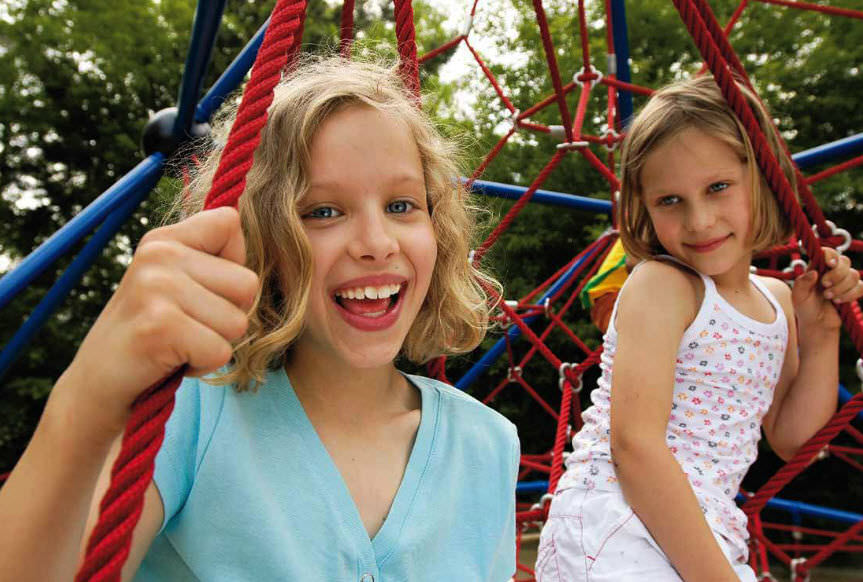
Three-dimensional and two-dimensional rope play equipment
Two-dimensional rope structures let children climb along a horizontal line, swing in a straight line, or keep their balance across a suspension bridge.
Three-dimensional rope structures are completely different: they can be woven together into many nets of different shapes and sizes. The structure can be tall or low, wide or narrow, but it always provides many different forms of play, making children's fun more exciting and safe with:
- Children can join the play from any position on the equipment (there is no fixed starting point)
- There is no need to follow any predefined route
- An open play environment that improves children's social interaction
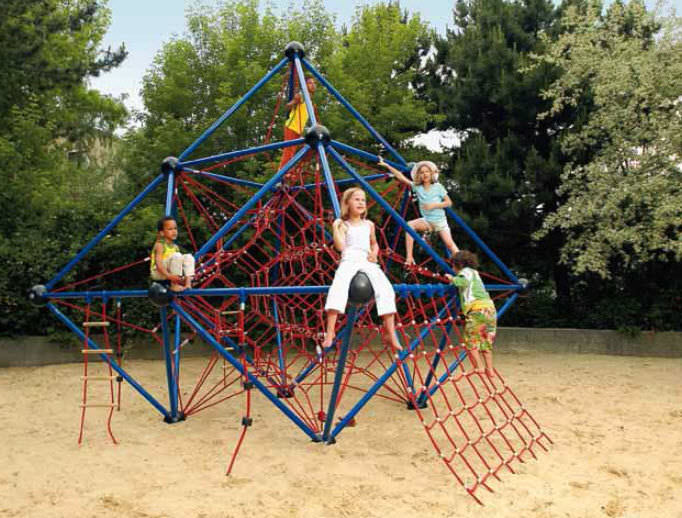
Every action a child makes is answered by the equipment through the shaking and stretching of the rope net system. For children who cannot climb, lack the strength, or simply do not enjoy climbing, they can grip the rope and feel the up-and-down, swaying movements and apply force to the rope, adding to the fun. Rope play equipment can also be adjusted to suit the players' preferences. For example, for teenagers and young people who enjoy a challenge, you can widen the gaps between the ropes; conversely, when training children's sensory and balance skills, you can narrow those gaps.
One thing to note is that all playgrounds must comply with ADA standards and regulations. This means that all play equipment of every size must have means of transfer (such as a transfer station or a platform) to help children with disabilities join the play as easily as other able-bodied children.
In fact, transfer stations and platforms are not mandatory. ADA regulations always leave room for more advanced, more effective equipment to develop. For example, a rope net connected to the main net system, or a net close to the ground that lets children gradually grip and climb up.
Most rope structures have a transfer belt supporting the player. There is no further need for transfer equipment or devices. The ultimate goal of rope play equipment is to encourage children with disabilities to leave their wheelchair whenever they want.
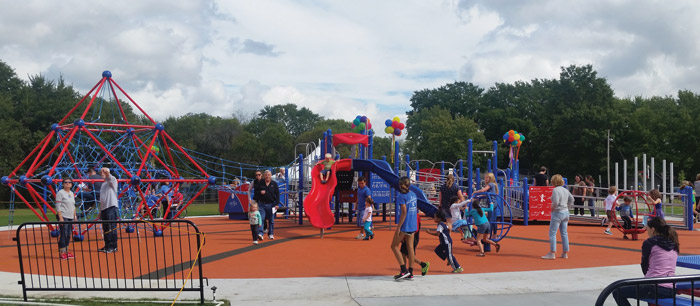
Some rope play equipment has built-in seats, such as the nest swing, which is very suitable for children who use wheelchairs. A comfortable seat is often the favourite play spot of any child, able-bodied or not, and playing together helps increase their social interaction.
The challenge from low-level rope nets always stimulates visually impaired children. They will have a strong desire to climb the net, while hearing-impaired children can use sign language without any obstacle.
Playing with ropes improves communication between children and their carers. Some children speak or hear unclearly. Play can be seen as the most effective way for children to develop communication skills. In a noisy, lively play environment, children are forced to use body language to communicate with each other and with carers; and because rope play equipment can be seen straight through, communication and understanding between those inside and those outside keeps improving.
Rope play equipment can combine the experiences of all the senses, giving children great joy, especially children with autism and sensory disorders.
Rope nets provide a play space that connects everyone, whether visually impaired, hearing impaired, or physically or intellectually disabled. Everyone can take part, experience and play freely with even the simplest games, and through that understand and accept each other's differences.


